Valuation campaigns
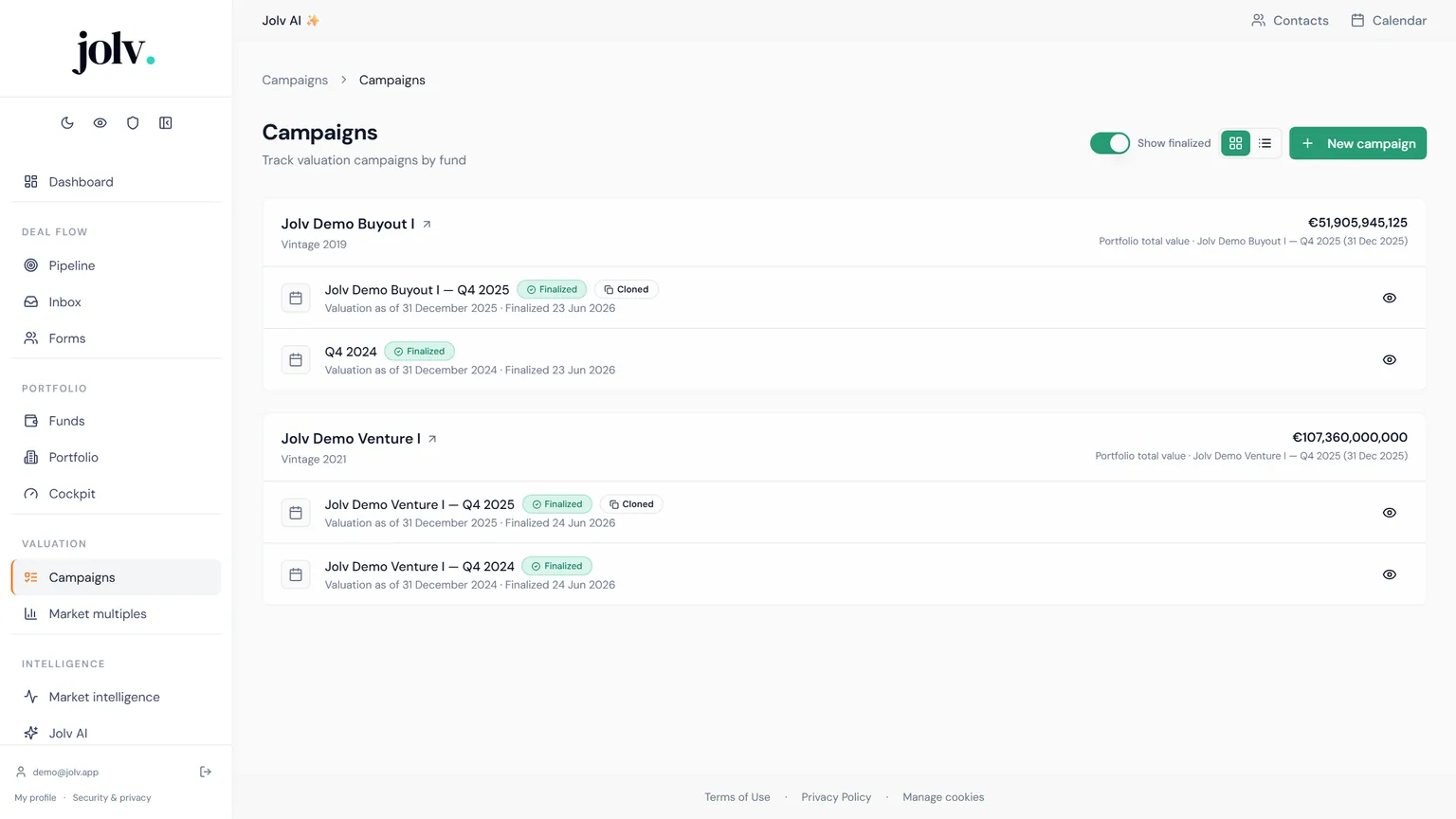
End-to-end multi-campaign management: creation, cross-campaign comparison, secure executive input, usable decision history. Discover Jolv features: portfolio dashboard, valuation campaigns, Kanban deal flow, Jolv AI, exports and collaboration. Software for PE/VC funds. All features · Home · Fund security
Product capabilities
- Create, duplicate and close campaigns
- Valuation sheets per instrument with comments and context
- Cross-campaign comparison and variation tracking
- Executive input via secure link for data and documents
Business benefits
- Standardised valuation process
- Less manual rework
- Robust decision history
Method
Updated
A campaign fixes a valuation date and walks the path to fair value holding by holding: method used, aggregate, market or transaction multiple, the bridge from enterprise value to the fund's share, then approval. Every step is timestamped and attributable; once the campaign is frozen the figures stop moving (Freeze & Lock) and a correction becomes a new version rather than a rewrite.
Calculation convention
EV = aggregate × adjusted multiple → Equity = EV − net debt → Holding FV = Equity × ownership
The illiquidity discount (DLOM) applies to the multiple by default, consistent with IPEV 2025 §3.4, which addresses lack of liquidity when adjusting multiples. An option moves it to the fair value of the holding, at the end of the bridge. Never to net debt, never to 100% Equity.
Worked example (illustrative)
Illustrative holding owned at 35.0%: EBITDA of 4,000 KEUR, comparables multiple of 8.00×, illiquidity discount of 20.0% applied to the multiple, net debt of 9,000 KEUR.
| EBITDA used | 4,000 KEUR |
|---|---|
| Multiple after discount | 6.40× |
| Enterprise value | 25,600 KEUR |
| Net debt | − 9,000 KEUR |
| Equity 100% | 16,600 KEUR |
| Fair value of the holding (35.0%) | 5,810 KEUR |
At the same rate, applying the discount to the holding's fair value rather than to the multiple does not give the same result: applied to the multiple, it runs through enterprise value and reaches equity geared by leverage. Jolv records which location was used, so the review argues about an explicit choice.
Review points
- Discount applied after net debt, on 100% Equity: it then bears on a value that already includes leverage.
- A comparables multiple taken as is, without a size or growth adjustment, then discounted a second time.
- A campaign corrected in place after it reached the committee: without a new version, the audit trail no longer says which figure was presented.
Frequently asked questions
- Where does Jolv apply the illiquidity discount (DLOM)?
- To the multiple by default, consistent with IPEV 2025 §3.4, which addresses lack of liquidity when adjusting multiples. A setting applies it to the fair value of the holding instead, at the end of the bridge. It never applies to net debt, nor to 100% Equity.
- What exactly does a campaign's Freeze & Lock lock down?
- The valuation date, the aggregates, the multiples and the approved fair values. After freezing, a change creates a dated, attributable version instead of overwriting what exists: the figure shown to the committee stays readable as it was shown.
See this feature in a real context
Customised demo on your portfolio and deal flow process.
Related reading : Quarter-end close: why valuation is the real bottleneck, Valuation policy: what auditors and investors actually look for
See also : Unified dashboard, Portfolio valuation software, Deal Flow