Portfolio valuation software
All participation data (financials, instruments, contacts, documents) in a single source of truth, no more scattered files. Discover Jolv features: portfolio dashboard, valuation campaigns, Kanban deal flow, Jolv AI, exports and collaboration. Software for PE/VC funds. All features · Home · Fund security
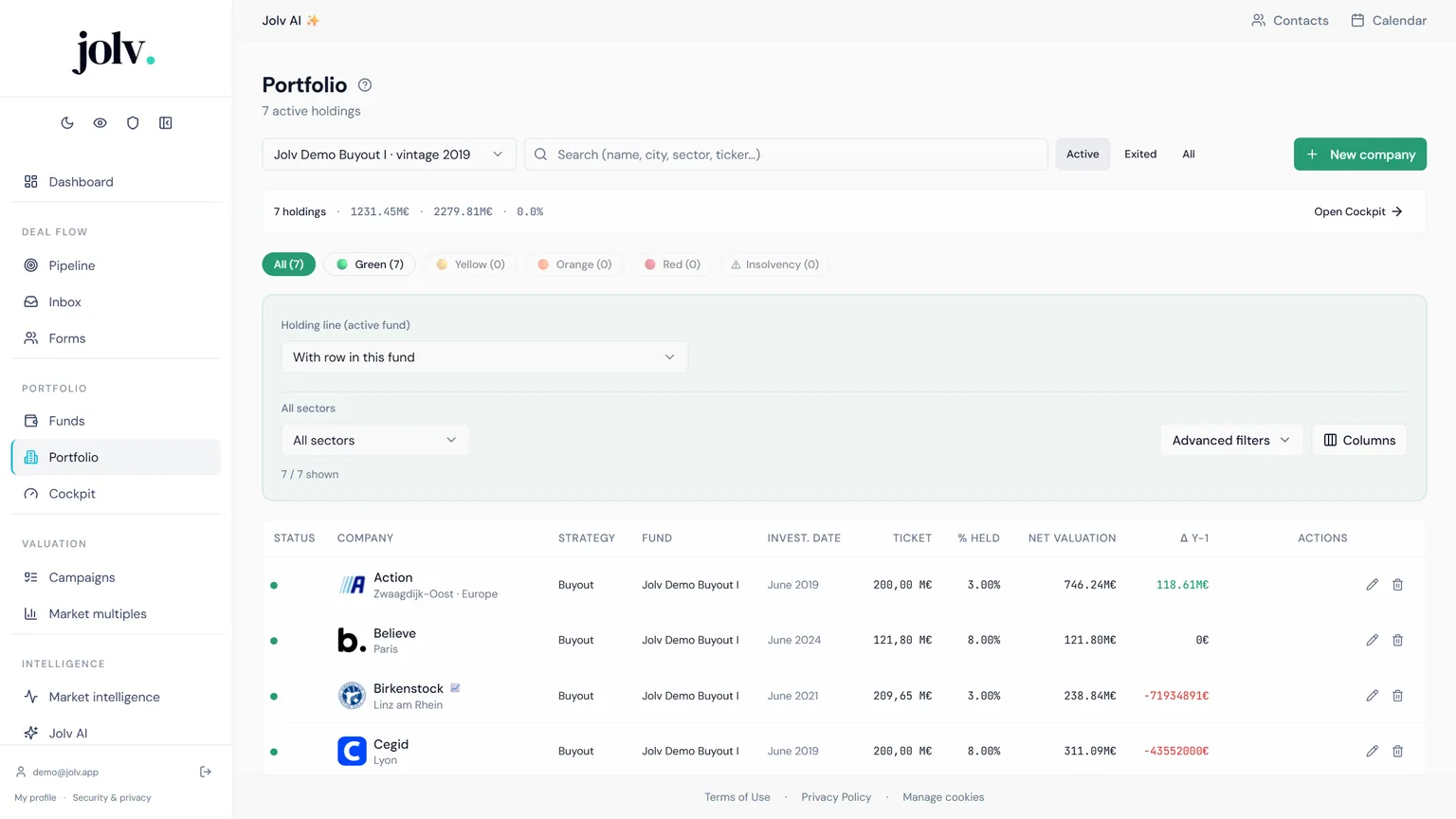
Product capabilities
- Holding files: financials, instruments, contacts, co-investors
- Movement tracking: exit, reinvestment, conversion, dilution
- Centralised documents: meeting notes, key events, valuation docs
Business benefits
- No more scattered files
- Reliable portfolio data
- Complete view per company
Method
Updated
A holding record gathers what valuation actually needs: the financial history in the order revenue, EBITDA, EBIT then net income; the instruments held with their entry cost; the cash flows received; provisions; contacts and documents. The multiples shown across the portfolio are recomputed from that data, never typed in by hand — which is what lets you trace a multiple back to the line that produces it.
Calculation convention
MoIC = (NAV + realised distributions) / invested cost · RVPI = NAV / invested cost
NAV over cost is an RVPI, not a MoIC — the most common confusion in monitoring spreadsheets. Jolv conventions on the edge cases: an earn-out or escrow only enters the numerator once received; a holding provisioned at 100% is worth 0.00×, not 1.00×; a debt repayment leaves invested cost unchanged, whereas capitalised PIK interest increases it.
Worked example (illustrative)
Illustrative holding: ticket of 10,000 KEUR, partial exit received for 6,000 KEUR, remaining stake valued at 8,000 KEUR in the latest campaign.
| Invested cost | 10,000 KEUR |
|---|---|
| Distributions received | 6,000 KEUR |
| Residual NAV | 8,000 KEUR |
| MoIC | 1.40× |
| RVPI | 0.80× |
The same holding reads 1.40× or 0.80× depending on the ratio used. Jolv shows both, with the flows that make up each numerator.
Review points
- A table labelled « multiple » that excludes distributions: that is an RVPI presented as a MoIC.
- Invested cost and called capital mixed from one line to the next: the DPI + RVPI = TVPI identity no longer holds.
- An earn-out counted at face value before it is received: the multiple rises without a single euro coming in.
Frequently asked questions
- How does Jolv compute the MoIC of a holding?
- (NAV from the latest campaign + realised distributions) / invested cost. NAV divided by cost alone gives the RVPI, which Jolv displays separately. A pending earn-out or escrow stays out of the numerator until it is received, and a holding provisioned at 100% is worth 0.00×.
- In what order is a holding's financial data tracked?
- Revenue, EBITDA, EBIT, then net income, across as many financial years as the record holds. That is the order a review expects, and the order of the aggregates later reused as a multiple base in a valuation campaign.
See this feature in a real context
Customised demo on your portfolio and deal flow process.
Related reading : MoIC or RVPI: two confused multiples, only one measures performance, Quarter-end close: why valuation is the real bottleneck
See also : Unified dashboard, Valuation campaigns, Deal Flow